Inside Smart Scheduling: Why the 15-Minute Block Matters
- inspiri_admin
- Nov 11, 2020
- No Comments
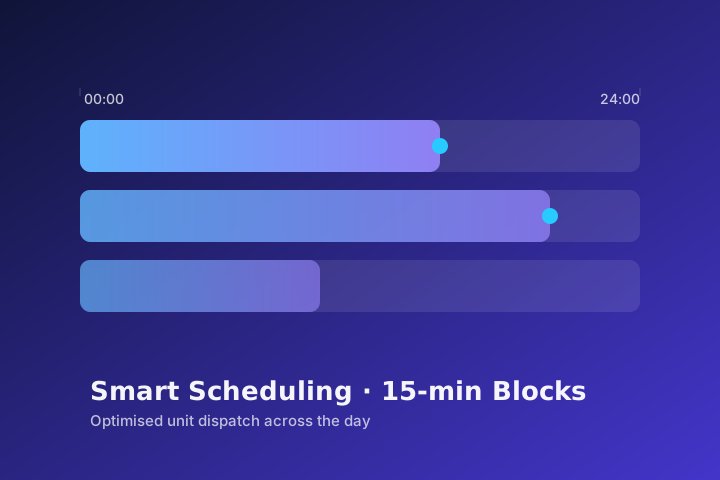
Revision windows, deviation settlements and renewable ramps all live at the fifteen-minute granularity. A look at how AI-driven scheduling turns millions of data points into cost-efficient unit dispatch.
Energy scheduling at a load dispatch centre is fundamentally a problem of granularity. Demand does not move in tidy hourly steps, renewables do not respect the clock, and deviation settlement charges are computed on fifteen-minute blocks. A schedule that is right on average can still be wrong in every block that matters.
The data behind the schedule
Our scheduling approach consumes telemetry from SCADA systems, weather feeds, historical load curves, unit outage calendars and market prices — millions of data points consolidated into a single optimisation. The AI layer then produces a dispatch trajectory that respects technical constraints while minimising the expected cost of power purchase and deviations.
- Block-level (15-minute) revision of generation and drawal schedules
- Deviation exposure estimated before it is incurred, not after
- Automatic prioritisation of cheaper available resources
- Scenario planning for renewable ramps and forced outages
Cost efficiency as an outcome, not a slogan
The measurable outcomes our clients target are specific: reduce Deviation Settlement Mechanism charges, shift procurement towards the cheapest compliant sources in every block, and give regulators a transparent, data-backed trail for every scheduling decision. Smart scheduling is where those three goals meet.
“The energy industry is undergoing an unprecedented transformation — from a conservative past to a new system where innovation is the key.”